Is your rental
property compliant?
Get our free compliance checklist so you can rent your home legally – and avoid fines.


The UK housing market for sales has cooled down as interest rates have gone up. But the rental market is still very hot. Rents for new lets are 25 per cent higher than before Covid-19 hit in 2020, according to Hamptons estate agents, and they rose by 9 per cent in May compared with the previous year.
UK rents have increased at a record-breaking pace for 12 months in a row until April this year, based on Office for National Statistics data from 2016. Even though the annual growth rate of rents seems to be slowing down, tenants will still find it hard to afford the rents that keep going up.
There is also a growing worry that there will not be enough rental homes as mortgage costs increase for landlords and make buy-to-let investments less appealing — or even impossible in some cases.
In the last few weeks, many of the big lenders in the UK, such as HSBC, Nationwide and Santander, have raised their mortgage rates, which puts more pressure on landlords.
“This is the worst balance between supply and demand we have ever seen, and it’s only going to get worse,” says Guy Gittins, chief executive of Foxtons. In April, the agency had 97,000 tenants looking for only 2,000 available properties. “Rents will keep rising faster than incomes unless we see a big increase in rental supply or a big drop in demand, both of which seem unlikely,” says Richard Donnell, executive director at Zoopla. The number of available rental properties listed on the site is currently 33 per cent lower than before the pandemic — and it has not changed much, as homes are rented out as soon as they are listed.
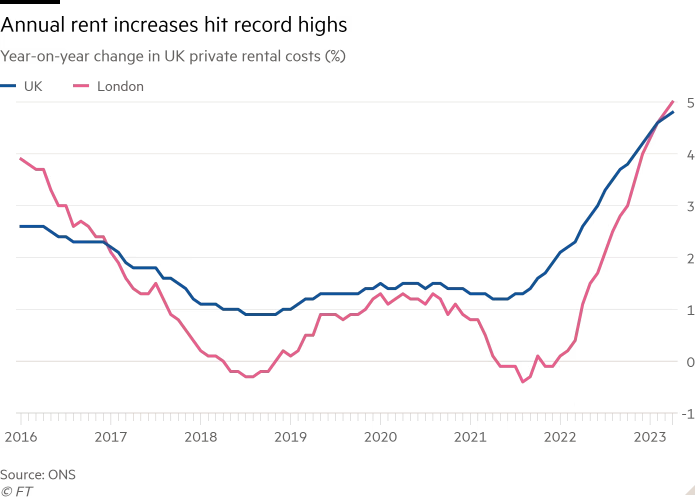
The UK rental market is facing a tough situation in 2023 and 2024, as high inflation, rising interest rates, and a cost of living squeeze are putting pressure on both landlords and tenants. The demand for rental properties remains strong, especially in London, where rents have increased by more than 15% in the past year. However, the supply of rental properties is limited, as many landlords have sold their properties or reduced their portfolios due to tax changes, regulatory reforms, and lower yields. This has created a competitive and expensive market for renters, who are spending a large proportion of their income on rent.
For landlords who are considering renting out their London properties or getting a buy-to-let in London, there are some factors to consider. On the positive side, London offers high rents and occupancy rates, as well as a diverse and resilient tenant base. There is also strong demand from overseas buyers who are taking advantage of the weaker pound and the post-pandemic recovery. On the negative side, London has the lowest rental yields in the UK, as well as the highest property prices and mortgage costs. Landlords also face higher taxes, stricter regulations, and more competition from other sectors of the private rental market.
According to some experts, the UK housing market is unlikely to crash, but will experience a correction in 2023, with house prices falling by around 6% on average. This could create an opportunity for landlords to buy properties at a lower price and benefit from future capital growth. However, this also depends on the local market conditions, the type and quality of the property, and the availability of finance. Some cities and regions may fare better than others, and some types of properties may be more attractive to tenants than others.
In summary, the UK rental market is undergoing a transition period that poses both challenges and opportunities for landlords. London remains a lucrative but risky market for buy-to-let investors, who need to weigh up the costs and benefits carefully. Landlords who can adapt to the changing needs and preferences of tenants, as well as the economic and regulatory environment, may be able to secure a profitable and sustainable income from their rental properties.

Increasing mortgage rate stress tests from 4.5% to 6% could cause landlords with larger loans to fail affordability checks, especially in London and the South East. New buyers and those refinancing may need to lower their loan-to-value ratio or even sell their properties.
Bar chart showing how increasing mortgage interest rates from 2% to 4.5% and 6% could cause landlords with larger loans to fail affordability checks, especially in London and the South East.
The tax changes, which came along with a rise in the stamp duty for rental properties, have made some landlords unable to make a profit. A typical landlord who refinances a 2.2 per cent two-year fixed-rate mortgage this year at a new rate of 6 per cent would have to increase the rent by 31 per cent to cover the extra cost, according to Hamptons.
“We have had three landlords in the past week who have to sell because they can’t afford their mortgage,” says Hollie Hart, a south London agent.
The steady income from a rental property was attractive during the time of very low interest rates. Now, investors have more choices. “You can put money into Treasury bills at 4 per cent with no risk of the boiler breaking down or your tenants not paying rent on time,” says Jo Eccles, managing director of agency Eccord, which also manages rental properties for landlords.
The demographics of UK landlords could also lead to more of them leaving the market, as those who bought properties in the early days of buy-to-let want to cash in their investments. Some 140,000 landlords retired last year, according to Hamptons, which says changing demographics will lead to more landlord sales in the next five years.
“There is a sort of natural life cycle to that buy-to-let market,” says Sandra Jones, managing director at research consultancy Dataloft. “There was probably always going to be a generation of landlords who wanted to cash in their assets at this point, and Covid concentrated that.”
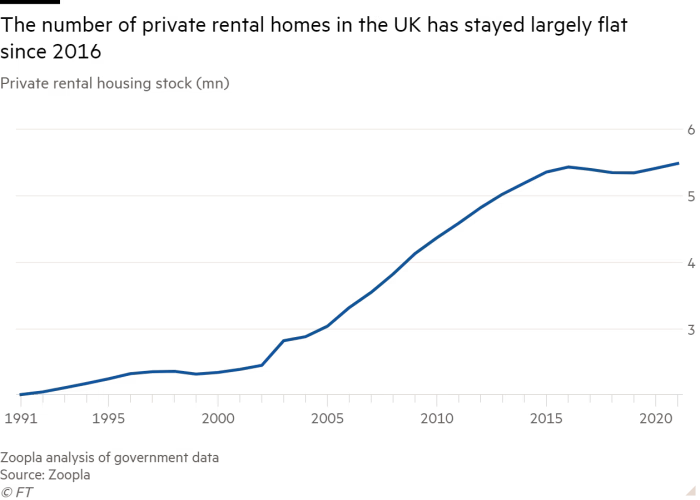
So far, the bad news for landlords has meant too few new properties coming on to the rental market. The popularity of buy-to-let mortgages made the number of privately rented homes double from 2002 to 2015, according to Zoopla. But since then, the number has stayed mostly flat as tenant demand has increased.
Net migration in the UK reached a record high in 2022, at 606,000 people, most of whom will look for a rental home, according to Capital Economics, which says the surge in migration may have increased rents by 3 to 7 per cent.
The renters reform bill, introduced by Michael Gove, the levelling up and housing secretary, aims to change the UK rules for renting to suit a market where more people will rent for longer and fewer people will own homes. The bill would stop “no fault” evictions, which means landlords could only evict tenants for a reason, such as not paying rent or wanting to live in the property themselves.
The bill has been praised by tenant advocates and by many property companies, including Grainger, the UK’s biggest listed landlord. But some people say the bill will make it harder for prospective landlords to rent out their properties.
Cook says the bill will help current tenants who have a rental home that meets their needs for the next few years, who will have more security and “a stronger position at rent review”.
But for those who want to rent their first home, or who need to move, the new rules could make it even harder to find a place. The rental market has already become less dynamic as tenants are scared to move and want to keep the good deals they got during Covid.
The response to the rental reform shows the political difficulty of the rental market. Measures that favour landlords benefit richer people who can afford an investment property, but measures that put more pressure on landlords are criticised for reducing the supply of rental properties and increasing the pressure on tenants. Cook says the main risk is that the reform bill could “make the problem of lack of supply worse. That is the political problem in a nutshell.”
The bill is one of several new challenges for landlords, which have caused worry that the UK is close to a big sell-off by buy-to-let landlords.
More homeowners will see their monthly costs go up when their fixed-rate mortgages end, exposing them to higher rates. The government has also said it wants to make landlords improve the energy efficiency of their properties to an Energy Performance Certificate C grade by 2030. The details of new rules have not been decided yet, but upgrading a property could cost thousands of pounds extra.
With private landlords leaving, new rental homes built by big institutional investors are often seen as a source of new supply. These “build to rent” schemes are more popular with big property investors because of their steady income, but they only provide 82,500 homes, with another 168,000 planned or under construction, according to Savills.
Higher financing costs and planning limits will make it hard for these developments to meet demand. “We don’t think it is possible to build enough new units in the places where people want to live in the next five or six years,” says Gittins.
Donnell says high rent rises will probably continue this year and maybe into 2024, unless there is a big increase in unemployment, a big decrease in immigration, or a big increase in the supply of rental homes.
The UK rental market is facing a challenging situation in 2023 and 2024, as high inflation, rising interest rates, and a cost of living squeeze are putting pressure on both landlords and tenants. The demand for rental properties remains strong, especially in London, where rents have increased by more than 15% in the past year. However, the supply of rental properties is limited, as many landlords have sold their properties or reduced their portfolios due to tax changes, regulatory reforms, and lower yields. This has created a competitive and expensive market for renters, who are spending a large proportion of their income on rent.
For landlords who are considering renting out their London properties or getting a buy-to-let in London, there are some factors to consider. On the positive side, London offers high rents and occupancy rates, as well as a diverse and resilient tenant base. There is also strong demand from overseas buyers who are taking advantage of the weaker pound and the post-pandemic recovery. On the negative side, London has the lowest rental yields in the UK, as well as the highest property prices and mortgage costs. Landlords also face higher taxes, stricter regulations, and more competition from other sectors of the private rental market.
According to some experts, the UK housing market is unlikely to crash, but will experience a correction in 2023, with house prices falling by around 6% on average. This could create an opportunity for landlords to buy properties at a lower price and benefit from future capital growth. However, this also depends on the local market conditions, the type and quality of the property, and the availability of finance. Some cities and regions may fare better than others, and some types of properties may be more attractive to tenants than others.
At Intra Capital Estates, we understand the complexities of being a landlord and are committed to supporting landlords in navigating these changes. Our team of experienced professionals is here to assist you with expert advice, tailored solutions, and comprehensive property management services.
If you have any questions or would like to learn more about the short term future of London rentals, or our range of services, we invite you to get in touch. Our dedicated team is ready to address your inquiries and provide the assistance you need to thrive in the evolving rental landscape.
Stay informed, stay proactive, and let Intra Capital Estates be your trusted partner in the ever-changing world of property management.
Please note that the information provided in this blog post is intended for general guidance purposes only and should not be considered as legal advice. Visit gov.uk for more information.
Get our free compliance checklist so you can rent your home legally – and avoid fines.
Want to discuss something more specific? Contact us, and we will be more than happy to help you.
"*" indicates required fields


The eviction process has changed significantly in 2026 – Section 21 has been abolished, and all London landlords now need to use Section ...

The new Renters’ Rights legislation has now passed, bringing major reforms to the private rented sector in England. These changes will di...

Central London’s urban density can make it challenging to keep mice, rats or the dreaded bed bugs away. Private landlords are responsible...


